US Manufacturing · Pursuing Domestic End Product Status
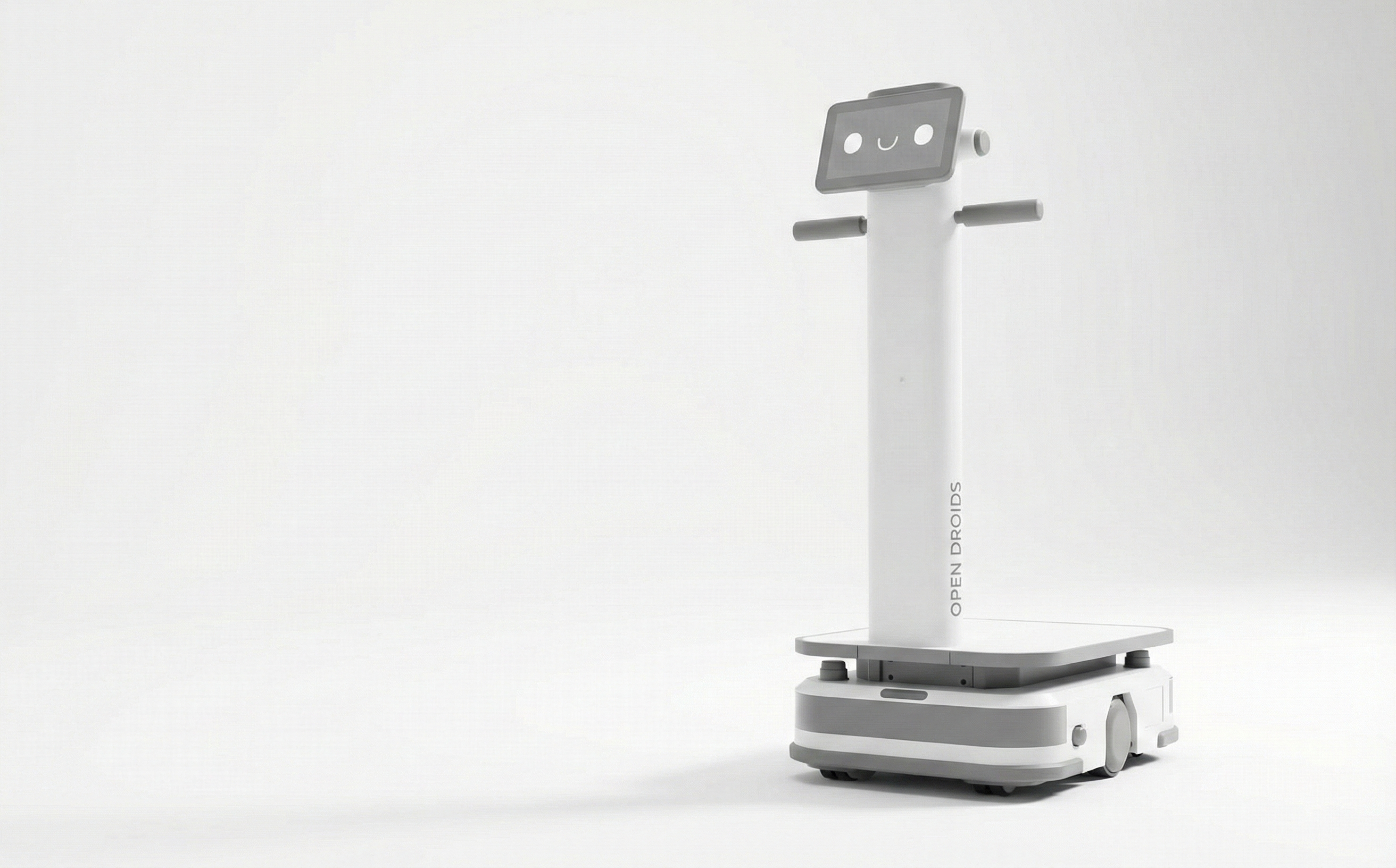
The robots created by OpenDroids are designed for America.
OpenDroids makes commercial service robots designed and engineered in the United States and actively seeks a transition path to the FCC's ruling of July 2026 which will allow for U.S. final assembly of service robots for use as a domestic end product under 48 CFR §25.101(a) for operators seeking a compliant transition path after the ruling.
Domestic end product
Under 48 CFR §25.101(a), a domestic end product requires final assembly in the United States. OpenDroids is building toward that status for its commercial fleet.
65%+ US component cost
Domestic end product status also requires more than 65% US component cost the threshold that separates compliant platforms from restricted foreign-produced devices.
DA-26-786 exemption path
Robots that qualify as US domestic end products are exempt from FCC restrictions on foreign-produced advanced robotic devices after the July 28, 2026 ruling.
Manufacturing roadmap
We have a commitment to manufacture in the USA.
OpenDroids has offices in the United States, and partnerships with NVIDIA Inception and Google DeepMind. We are working hard to begin final assembly in the USA, so our commercial/end products, restaurant, hospitality, healthcare, warehouse, airport, manufacturing and retail robots, will be considered domestic goods under 48 CFR §25.101(a).
That law stipulates that the domestic end product must be completed in the United States using over 65% US component cost. Robots that cross the threshold are not subject to FCC DA-26-786 restrictions on foreign produced advanced robotic devices.
We are accepting consultations for businesses affected by the ruling. Contact us to discuss your situation and our compliance timeline or see FCC-compliant robot options.
- Pursuing domestic end product status under 48 CFR §25.101(a)
- Building toward Buy American aligned eligibility
- DA-26-786 transition consultations open now
- RaaS deployment. no upfront hardware cost
Policy context
Why the US government moved to protect domestic robotics
The FCC's July 2026 ruling did not happen in a vacuum. It is the most visible action in a years-long policy shift toward domestic technology production one OpenDroids has been building toward since the company's founding.
Robots with LiDAR, cameras, acoustic sensors, and persistent network connectivity are not only productivity tools. They are data collection platforms. A foreign-produced robot navigating a US hospital, warehouse, or airport can collect high-fidelity maps, audio, and environmental data.
The ruling followed real security incidents involving foreign robots including remote access to camera feeds and floor maps, pre-installed backdoors, and network-spreading exploits. The policy conclusion: critical infrastructure cannot run on platforms the US government cannot verify or trust.
$11.4B
US robotics market in 2026
Growing at ~29% year-over-year
65%+
US component cost required
For domestic end product status under 48 CFR §25.101(a)
2022–2026
Industrial policy wave
Largest US manufacturing investment push in generations
Long term advantage
Why US assembly produces a better robot for US businesses
No supply chain uncertainty
Foreign assembled robots depend on overseas logistics, ports, and trade policy. A US assembly path means your deployment timeline is less exposed to geopolitical disruption, tariffs, and overseas customs delays.
Cybersecurity you can audit
US final assembly puts software supply chain, firmware provenance, and update mechanisms under US jurisdiction verifiable by US security teams. For hospital systems, federal contractors, and critical infrastructure operators, that auditability is increasingly a requirement.
Faster support same timezone
US-based monitoring, maintenance, and support. When a robot needs attention, you are not waiting on a 12-hour lag to an overseas ticketing center.
Building toward procurement eligibility
Domestic end product status under 48 CFR §25.101(a) unlocks federal, state, hospital, and defense-adjacent procurement channels unavailable to foreign robot vendors. OpenDroids is building toward that status for its commercial fleet.
Upgrade path with certainty
Foreign manufacturers under Conditional Approval face undefined timelines. A US assembly strategy is designed for permanence not a temporary waiver.
Aligned with US industrial policy
CHIPS Act funding, industrial policy, and tariff protection continue to favor domestic technology production. OpenDroids' US assembly roadmap positions clients on the durable side of that shift.
Policy direction
The policy direction is clear and durable
OpenDroids' US assembly roadmap is not a reactive scramble after DA-26-786. It reflects a policy environment that has been moving in one direction for years.
2022
CHIPS Act
$52B+ in domestic semiconductor and advanced technology manufacturing incentives signaling a lasting shift toward domestic technology production.
2025
Foreign drone ban
The FCC adds foreign-produced unmanned aircraft systems to the Covered List establishing the template later applied to robots.
2025
National Security Strategy
The White House calls for reindustrialization and investment in critical and emerging technology sectors that will define the future including robotics.
July 28, 2026
Foreign robot ban
FCC DA-26-786 adds foreign-produced advanced robotic devices to the Covered List. US domestic end products are the clear compliant path for new model deployments.
Companies that invest in US manufacturing capacity before and through the July 28, 2026 ruling are positioned to serve the post-DA-26-786 market. OpenDroids is building that capacity and accepting transition consultations now.
Buyers
Who US manufacturing matters for and why
Federal and state government agencies
Government procurement under FAR regulations increasingly requires domestic end product sourcing. OpenDroids is pursuing 48 CFR §25.101(a) qualification so agencies have a US-based robotics path to evaluate.
Hospital systems and healthcare networks
Hospital procurement teams run cybersecurity vendor assessments that foreign-produced connected devices increasingly fail. A US assembly and support path reduces that exposure for delivery, specimen transport, and disinfection robots.
Defense contractors and regulated industries
Operators under ITAR, CMMC, or similar frameworks face strict supply-chain sourcing rules. A domestic assembly roadmap is built for environments where foreign technology is restricted.
Enterprises with multi-site deployments
Restaurant groups, hotel chains, and retail networks need a stable, scalable US supply chain. Domestic assembly reduces trade-policy and authorization uncertainty at enterprise scale.
Technology
World-class technology. US assembly roadmap.
US manufacturing does not mean falling behind on capability. OpenDroids combines a domestic assembly roadmap with advanced robotics AI partnerships compliance path and frontier platform together.
NVIDIA Inception Program
OpenDroids is an NVIDIA Inception partner. Our robots leverage NVIDIA's robotics AI stack for navigation, perception, and autonomous operation.
Google DeepMind Partnership
AI development supported by a Google DeepMind partnership frontier research applied to robot learning and real-world autonomous behavior.
Backed by: Tether · DNA Fund · Percival VC · Blockchain Founders Fund · Welara
As recognized by: Mashable · CNET · TechCrunch · The Robot Report · MSN · Yahoo
R1D1
OpenDroids' commercial platform — designed and engineered in the US, with a US final-assembly roadmap.
View R1D1Industry deployments
Restaurant, hospitality, healthcare, warehouse, airport, manufacturing, and retail configurations on RaaS.
See FCC-compliant optionsMeet the team
The people building OpenDroids' US robotics roadmap.
About OpenDroidsFAQ
Frequently asked questions
Where are OpenDroids robots manufactured?
OpenDroids is a US-based robotics company actively pursuing final assembly in the United States to qualify as a domestic end product under 48 CFR §25.101(a). Contact us for the current compliance timeline and how it applies to your deployment.
Do OpenDroids robots qualify as Buy American products?
OpenDroids is working toward domestic end product status under 48 CFR §25.101(a), which requires US final assembly with more than 65% US component cost. We are accepting consultations for operators who need a Buy American aligned robotics path. Contact us to discuss timeline and documentation.
Why does US manufacturing matter for commercial robots?
Following the FCC's July 2026 ruling (DA-26-786), robots that qualify as US domestic end products are exempt from restrictions on foreign-produced advanced robotic devices. US assembly also reduces foreign data exfiltration risk, trade policy disruption, and supports government and regulated-industry procurement requirements.
Can government agencies and hospitals purchase OpenDroids robots?
OpenDroids is accepting assessments for government, hospital, and regulated-industry buyers who need a US-based robotics transition path. Contact us for procurement documentation needs and our compliance roadmap.
Is US-assembled really as capable as foreign-made robots?
OpenDroids combines a US assembly roadmap with NVIDIA Inception Program AI and a Google DeepMind partnership. US assembly is about compliance and supply-chain security not a capability trade-off. Robots navigate with LiDAR and computer vision, integrate with POS/WMS systems, and are monitored by a US-based team.
What percentage of an OpenDroids robot is manufactured in the US today?
OpenDroids is actively pursuing the 65%+ US-component-cost threshold required for domestic end product status under 48 CFR Section 25.101(a). Current status and timeline are confirmed directly during a compliance consultation, since this build-out is in progress rather than complete.
Does US assembly mean a robot costs more?
Not necessarily. OpenDroids' RaaS pricing is a flat monthly subscription regardless of assembly location, and U.S. assembly can reduce total cost exposure from tariffs, customs delays, and overseas supply-chain disruption over the life of a deployment.
Ready for US-based robots with a compliance roadmap?
OpenDroids is accepting new deployments across US markets. Assessment, configuration, and staff training included. Operational in 30 days from first call.
US-based company · Pursuing 48 CFR §25.101 · NVIDIA Inception · Google DeepMind

© 2026 Open Droids. All rights reserved.